How to Track Calories: How to Actually Log Your Food
By:Author:Air Diet Editorial
Updated on:October 20, 2026

- Does Logging Food Actually Change What You Eat?
- What Actually Happens When You Log a Meal
- How Much Detail Does Calorie Tracking Need?
- Logging Everything Versus Logging What Matters
- Fitting Calorie Tracking Into a Normal Week
- Can Tracking Calories Target Where You Lose Weight?
- The Factors That Decide If Tracking Sticks
- Where Calorie Logging Goes Wrong Week to Week
- Making Calorie Tracking Easier With Air Diet
- Building a Calorie Log You Will Actually Keep
Tracking calories means writing down roughly what you eat and drink so you know your energy intake, then comparing that to what your body burns. It works because a deficit over time is what drives weight change, and you cannot manage a number you have not measured.
The mechanism is simple arithmetic, not magic: eat less than you burn, over weeks, and the scale tends to move down. Eat more than you burn, and it tends to move up. Tracking just makes that number visible instead of guessed at.
This guide covers whether tracking actually works, how much detail you need day to day, the mistakes that sink most attempts, and how a structured meal plan can take the guesswork out of the whole process.
Does Logging Food Actually Change What You Eat?
Writing food down before you eat it changes behaviour before it changes the scale. People eat differently when they know they have to log the extra biscuit, and that small friction is most of the effect.
Here's the arithmetic. If a biscuit is roughly 80 calories and you skip it five days out of seven because logging it feels like admitting it, that's 400 calories a week you didn't eat - without changing a single meal.
That's not a dramatic number on its own. But stack a few of those small, visible choices together across a week and the total deficit becomes something you can actually feel on the scale over time.
What Actually Happens When You Log a Meal
There are two separate jobs happening every time you log food, and most people only do one of them.
Estimating What You Ate
This is the part people dread: weighing, measuring cups, scanning packet labels. It doesn't need to be exact - a reasonable estimate logged consistently beats a perfect measurement done once and abandoned.
Comparing It to a Target
The second job is checking that estimate against a daily number you're aiming for. Without this step, logging is just a diary - the comparison is what turns it into a decision-making tool.
Skip either step and tracking stops doing anything useful. Log without comparing and you've got a food diary with no direction; set a target without logging and you're guessing.
How Much Detail Does Calorie Tracking Need?
The honest answer is less than most people assume when they start.
Matching Effort to the Meal
A home-cooked dinner with three ingredients takes seconds to log. A restaurant meal or a mixed dish needs a rougher estimate, and that's fine - rough and consistent beats precise and occasional.
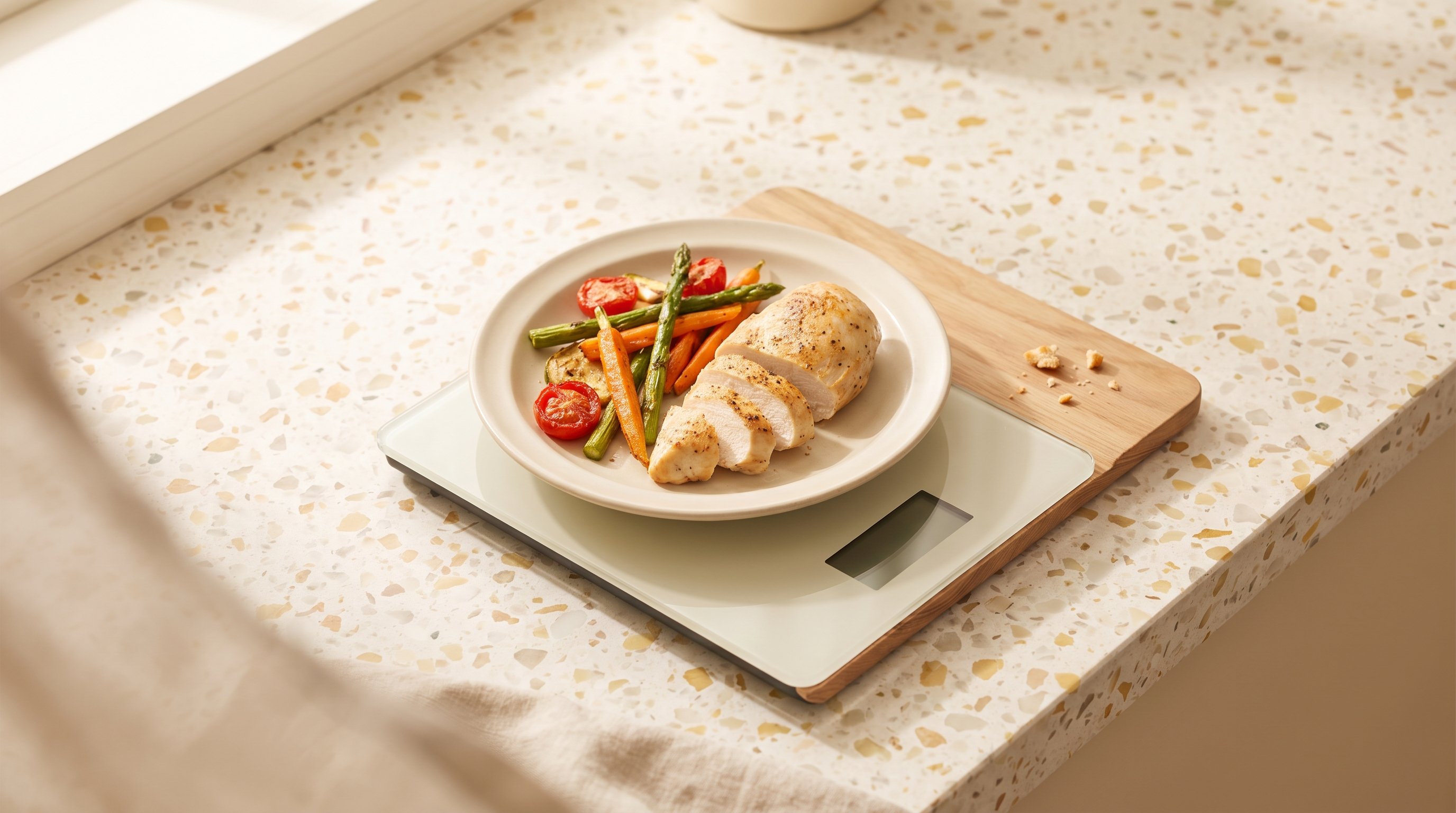
The table below gives a starting point for how much detail different meals realistically need.
| Meal Type | Realistic Detail Level |
|---|---|
| Home-cooked single dish | Weigh main ingredients once |
| Mixed home meal | Estimate portions by eye |
| Packaged food | Use the label figure |
| Restaurant meal | Closest match, round up |
| Snacks and drinks | Log every one, no skipping |
Logging Everything Versus Logging What Matters
There are two routes here, and they're worth naming honestly: logging every gram of every meal, or logging a smaller set of consistent meals you already know the numbers for.
The first route is more accurate on paper. It's also the one most people quit within a few weeks, because weighing rice at 7pm after a long day gets old fast.
The second route trades a bit of precision for something more valuable: you actually keep doing it. A rotation of five or six known meals, logged quickly because you've logged them before, holds up far longer than a perfect system nobody sticks with.
Fitting Calorie Tracking Into a Normal Week
The easiest way to keep tracking light is to reduce how many different meals you're estimating in the first place.
If breakfast and lunch repeat most days, you only need to work out their numbers once - after that it's recall, not research.
This is where a structured meal plan earns its keep. Air Diet builds a plan around air fryer recipes with known ingredients and portions, so a lot of the guesswork in logging is already done before you open the app.
Pairing that with the step, water and weight trackers inside the platform means the whole picture - food, movement, and progress - sits in one place instead of three.
Can Tracking Calories Target Where You Lose Weight?
No. This one needs saying plainly: no amount of careful logging lets you choose where your body loses weight from.
The body decides that on its own, and it's not something a food diary can influence no matter how precise the entries are. Tracking controls the size of the deficit, not its location.
The real answer is less exciting but more useful: a consistent deficit, held over time, tends to bring overall change. Where that shows up first isn't something logging calories can decide.
The Factors That Decide If Tracking Sticks
Not every habit around logging food carries equal weight. These three matter more than the rest.
What Actually Moves the Needle
- Logging before, not after - noting a meal before you eat it changes the choice itself, while logging after is just record-keeping.
- A repeatable set of meals - knowing the numbers for five or six regular meals cuts the daily workload to almost nothing.
- A target you actually check - a deficit only works if you compare your log to a number, not just collect entries.
Where Calorie Logging Goes Wrong Week to Week
Forgetting Liquids and Sauces
Oils, dressings and drinks add up fast and rarely get logged. Measuring them even roughly, instead of skipping them, closes one of the biggest gaps in most logs.
Setting a Target Too Low to Hold
A number that leaves you hungry by mid-afternoon gets abandoned by the weekend. A target you can actually sustain, even a less aggressive one, beats a strict one you quit on day ten.

Logging Only on Good Days
Skipping the log on takeaway nights or weekends hides exactly the data you need most. Logging the messy days is what makes the weekly average honest.
Treating One High Day As a Failure
One day over target doesn't undo a week of consistency. The weekly total matters more than any single entry, so there's no need to restart from zero after a rough day.
Making Calorie Tracking Easier With Air Diet
A lot of the friction in tracking calories isn't the maths - it's not knowing what to cook that fits the number you're aiming for.
Air Diet removes that guesswork with a plan built from over 1000 air fryer recipes, so meals arrive with their numbers already worked out instead of left for you to estimate from scratch.
Add in the nutrition and health guides written by nutrition experts, personal trainers and psychologists, plus the lifestyle challenges designed to build small consistent habits, and tracking stops feeling like a second job.

Get Your Diet Plan
Eat Smarter Every Day
Building a Calorie Log You Will Actually Keep
Pick one meal today and log it before you eat it, not after. That single switch does more for consistency than any app feature or perfect spreadsheet.
Start small, repeat the meals you already know, and let the habit build on its own timeline. A meal planning service can take the guessing out of what to cook, which leaves you with one less thing to track by hand.
FAQ
No - many people track closely at the start to learn their portions, then loosen up once the habit of eating that way feels automatic. Tracking is a tool for building awareness, not a lifetime sentence.
Logging food is just measurement, the same as checking a bank balance - it only becomes a problem if it starts controlling your day rather than informing it. Keeping entries rough and quick, rather than exact and stressful, keeps it in proportion.
You don't need to weigh everything - eyeballing portions for meals you cook often is good enough once you've measured them a couple of times. Air Diet's recipes come with the detail already worked out, which cuts that step out entirely.
Most people quit because logging felt like a chore with no clear payoff, or because one off day made them feel like starting over. Keeping the log light and judging progress by the week rather than the day tends to keep people going longer.
Share this post