Beginner Home Workout: What to Do and How Much to Train
By:Author:Air Diet Editorial
Updated on:October 20, 2026

- Does a Beginner Home Workout Actually Build Strength?
- How the Muscle-Building Mechanism Works at Home
- How Many Days a Week Should Beginners Train at Home
- Why Home Training Beats Chasing a Gym Routine
- Fitting a Beginner Home Workout Into a Busy Week
- No, Home Workouts Cannot Target Where Fat Comes Off
- What Actually Changes Results for Home Training
- Mistakes That Slow Down a Home Workout Routine
- Supporting a Beginner Home Workout With Air Diet
- Making the First Few Weeks of Training Stick
A beginner home workout works best when it is short, repeatable, and needs nothing you do not already own. Three to four sessions a week of bodyweight moves - squats, push-ups, lunges, planks - is enough to build real strength without a gym membership.
The mechanism is simple: muscles respond to load and repetition, not to the postcode where the training happens. A living room floor applies the same resistance principles as a gym mat, provided the moves challenge the muscle enough to ask it to adapt.
This guide covers how often to train, what a week actually looks like, where beginners trip up, and how to keep the habit going once the first bit of motivation fades.
Does a Beginner Home Workout Actually Build Strength?
Yes, and the arithmetic is straightforward. A bodyweight squat loads the legs with roughly the body's own weight each rep; across three sets of twelve, that is thirty-six reps of resistance work, no barbell required.
Strength gains come from progressive challenge - more reps, slower tempo, or a harder variation of the same move - not from the type of building the workout happens in.
A beginner who does three honest sessions a week at home is doing more consistent work than someone who plans five gym sessions and manages one.
The honest caveat: a home workout without any added resistance will plateau faster than one using bands or dumbbells, simply because bodyweight has a ceiling. For someone starting from zero, that ceiling is a long way off.
How the Muscle-Building Mechanism Works at Home
Two things decide whether a home session does anything useful: the load on the muscle, and how consistently it repeats week to week.
Load Without a Gym Rack
Bodyweight exercises use gravity and body mass as resistance, so a squat, push-up, or glute bridge still forces the muscle to contract against real weight. Slowing the movement down or adding a pause at the bottom increases the time the muscle spends under tension, which raises the challenge without any extra equipment.
Repetition Over Time
A single hard session does very little on its own; the adaptation comes from doing similar work two or three more times across the week. That repetition is what tells the body the demand is real and worth building for, rather than a one-off event to shrug off.
How Many Days a Week Should Beginners Train at Home
Three sessions a week, spaced with at least one rest day between them, is a solid starting point for most beginners.
Why Three Sessions Beats Daily Training
Muscle adapts during rest, not during the workout itself, so three sessions with recovery days built in tends to produce steadier progress than training every day and never fully recovering.
| Day | Focus |
|---|---|
| Monday | Full body, lower emphasis |
| Tuesday | Rest or light walk |
| Wednesday | Full body, upper emphasis |
| Thursday | Rest or stretching |
| Friday | Full body, core and balance |
Each session can run fifteen to twenty-five minutes and still count; length matters less than whether the week adds up to three sessions done.
Why Home Training Beats Chasing a Gym Routine
A gym plan with commute time, membership cost, and opening hours only works if someone actually gets there; a home workout removes every one of those barriers.
The adherence argument is simple: a slightly less optimal workout done three times a week beats a theoretically perfect gym programme done once a month because the schedule never lined up.
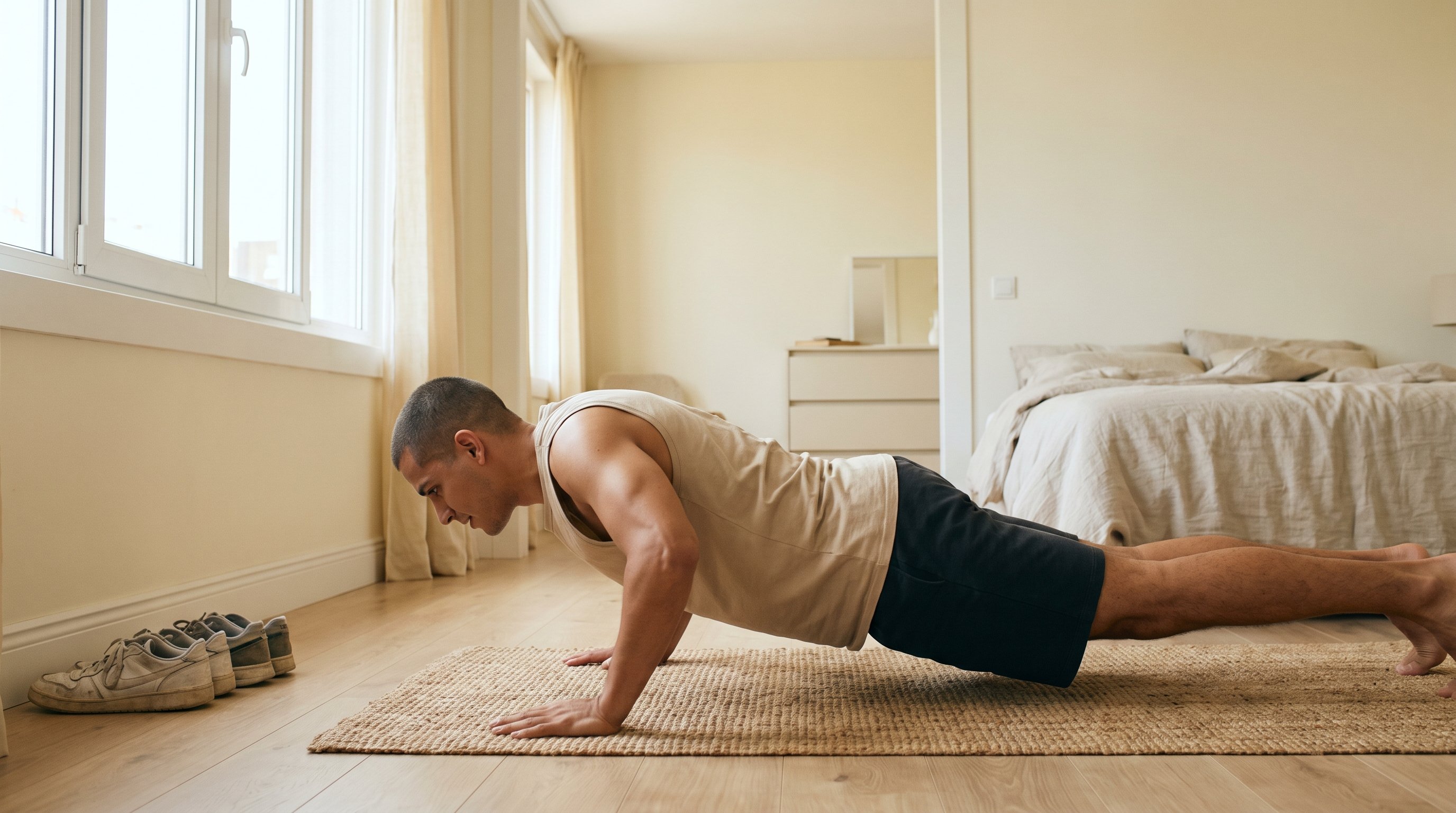
Named plainly, the choice is a fifteen-minute bodyweight circuit at home versus a forty-five-minute gym session that requires getting dressed, driving, and finding equipment free. The one that happens wins, every time.
Fitting a Beginner Home Workout Into a Busy Week
The easiest way to protect a home workout is to tie it to something that already happens daily - after brushing teeth, before the first coffee, or right when the laptop closes for the evening.
Keeping the kit simple also helps: a mat by the sofa or a towel on the floor removes the setup excuse entirely.
Air Diet keeps the workout side of this simple with over 100 workouts and exercises, including light sessions suited to someone starting from nothing, so there is a ready-made option instead of guessing what to do each day.
Pairing that with its progress tracking for steps, water, and weight means the workout habit sits next to the other small habits that support it, rather than living in isolation.
No, Home Workouts Cannot Target Where Fat Comes Off
A common hope is that enough crunches or squats will slim one specific area - the stomach, the thighs, the arms. That is not how the body works.
Fat loss happens across the whole body based on overall energy balance, and the body decides the order it releases fat from, not the exerciser.
The real answer is that a home workout builds strength and supports an overall calorie deficit, and the shape changes that follow happen everywhere at once, not in the spot that got trained hardest.
What Actually Changes Results for Home Training
Three things decide whether a beginner home workout turns into real progress, and they matter in roughly this order.
The Factors That Matter Most
- Consistency across weeks - three sessions every week for two months beats five sessions one week and none the next.
- Gradual increase in challenge - adding reps, slowing the tempo, or moving to a harder variation keeps the muscle responding instead of coasting.
- Recovery between sessions - sleep and rest days let the muscle actually adapt to the work it just did.
Mistakes That Slow Down a Home Workout Routine
Starting With Too Much Too Soon
A beginner who tries forty-five minutes of intense circuits on day one often cannot move the next day and skips the rest of the week. Starting with fifteen minutes and building up protects the habit more than it protects the ego.
Skipping the Warm-Up
Jumping straight into squats cold increases how much the first few reps feel like a struggle. Two or three minutes of marching on the spot or arm circles makes the rest of the session feel far more doable.
Never Changing the Routine
The same ten squats and ten push-ups every session for months stops asking anything new of the muscle. Adding a few reps or a harder variation every couple of weeks keeps progress moving.
Treating Rest Days As Optional
Training every single day without a break often leads to burnout or minor strain, which then forces a longer break than any planned rest day would have. One or two rest days a week is part of the plan, not a failure of it.
Supporting a Beginner Home Workout With Air Diet
A home workout holds up better when it is not the only habit someone is trying to build from scratch.
Air Diet pairs its light exercise library with a meal plan built around food you already like, cooked mostly in an air fryer, so the eating side of the week does not compete for the same willpower as the training side.
Its lifestyle challenges give small, specific goals to chase between workouts, and its progress tracking keeps steps, water, and weight visible in one place instead of scattered across memory and guesswork.

Get Your Diet Plan
Eat Smarter Every Day
Making the First Few Weeks of Training Stick
The single most useful action for anyone starting out is to pick three fixed days this week and do fifteen minutes on each one, nothing more ambitious than that.
Ready-made workouts and a food plan can sit alongside that effort to remove the guesswork, so the only decision left each day is showing up.
FAQ
Yes, bodyweight training applies real resistance to the muscles involved, and consistent sessions over weeks build strength the same way gym training does. The results depend far more on how often it happens than on where it happens.
For someone starting out, a home workout is often better because it actually gets done; a gym plan only helps if the person shows up consistently. Equipment adds options later, but it is not required to start building strength.
Most beginner bodyweight moves - squats, push-ups, lunges, planks - need a space roughly the size of a yoga mat and nothing else. A towel or a patch of floor is enough to start.
One missed week does not undo earlier progress; it just means restarting at a slightly lighter session and building back up over a few days. Air Diet's progress tracking makes it easy to see the gap honestly and pick the plan back up without starting from zero.
Share this post